
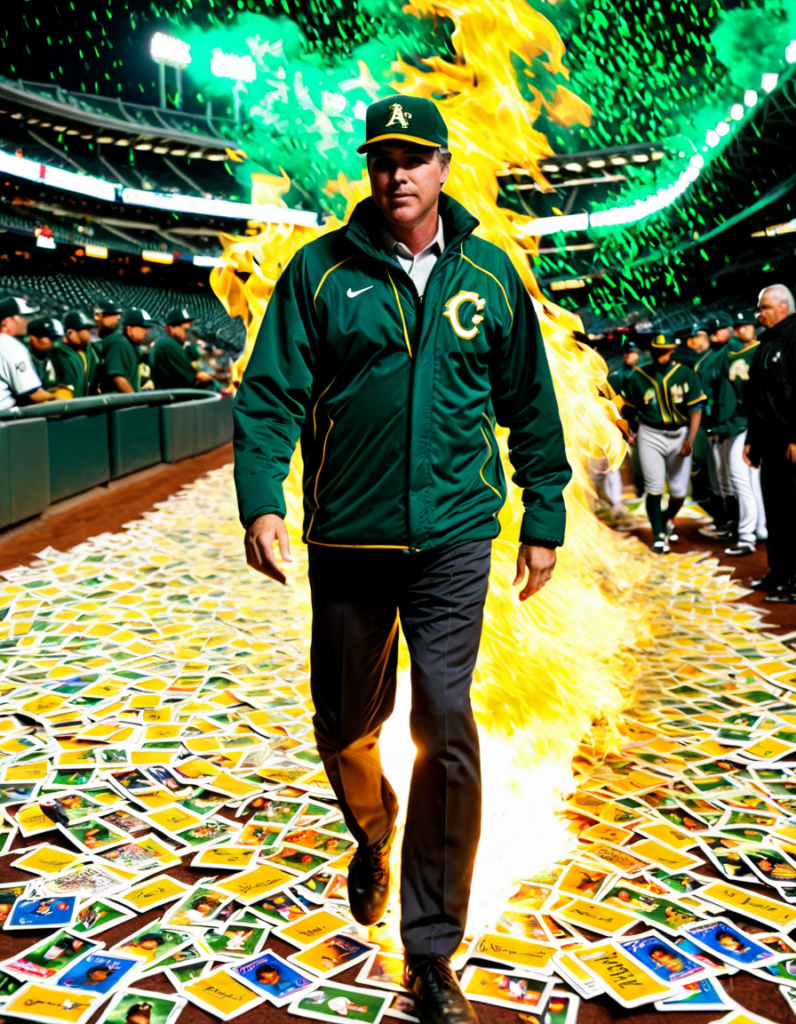
Billy Beane turned a brokeball team into a powerhouse by doing what no GM dared: ignoring scouts, trusting computers, and betting on misfits. What followed wasn’t just a movie-Moneyball-it was a revolution that redefined how baseball is played, built, and understood.
The Man Behind Moneyball: How Billy Beane Broke Baseball’s Old Code
| Attribute | Details |
|---|---|
| Full Name | Billy Beane (William Lamar Beane III) |
| Born | March 29, 1962, in Orlando, Florida, USA |
| Occupation | Baseball executive, former player |
| Notable Role | Executive Vice President of Baseball Operations, Oakland Athletics |
| Playing Career | MLB outfielder (1984–1989) – New York Mets, Minnesota Twins, Oakland Athletics, Detroit Tigers |
| Career Batting Average | .219 |
| Transition to Management | Began in scouting and player development with the Athletics in the 1990s |
| Claim to Fame | Pioneer of sabermetrics in baseball operations |
| Popularized By | Book *Moneyball: The Art of Winning an Unfair Game* by Michael Lewis (2003) |
| Film Adaptation | *Moneyball* (2011), starring Brad Pitt as Beane |
| Key Philosophy | Emphasized on-base percentage (OBP) and data-driven decision-making to compete with limited budgets |
| Team Success | Led Oakland A’s to four consecutive AL West titles (2000–2003), including a 20-game winning streak in 2002 |
| Legacy | Revolutionized front-office strategies across MLB; influenced analytics use in sports globally |
| Current Status | Still with Oakland Athletics front office (as of 2023), though role evolved after Chris Bassitt took over GM duties |
Billy Beane wasn’t just a general manager-he was a disruptor disguised as an executive. Hired by the Oakland A’s in 1997, Beane inherited a franchise ranked near the bottom in payroll, expected to lose quietly while richer teams hoarded talent. But instead of playing by traditional rules-heavy on home runs, star reputations, and gut instinct-he turned to data, hiring a Yale economics grad with zero baseball experience: Paul DePodesta.
This wasn’t just a personnel shift. It was a tectonic cultural clash. Old-school scouts mocked the move, calling DePodesta “the nerd” and dismissing statistical models as “witchcraft.” Yet under Beane’s leadership, the A’s began using On-base percentage (OBP), Slugging percentage, and Player efficiency metrics To identify undervalued talent-players who walked a lot, got on base, but didn’t fit the “look” of a major leaguer.
The results were impossible to ignore. In 2002, Oakland won 103 games-the same as the New York Yankees-with less than a third of their payroll. The baseball world took notice, but most still shrugged. That would change fast.
Was He Really the First to Think Differently? Debunking the Myth
Let’s be real: Billy Beane didn’t invent sabermetrics. That credit goes to Bill James, the Kansas dishwasher-turned-statistics revolutionary whose self-published newsletters in the 1970s exposed the flaws in how teams evaluated players. James proved OBP mattered more than batting average and that defense was often overrated. But for years, MLB front offices ignored him-until Beane didn’t.
Beane wasn’t the pioneer, but he was the First to weaponize analytics at scale. The key difference? He had power. While others debated stats in basements or blogs, Beane had control over a big-league roster. His genius was taking theory and turning it into wins.
Other teams had dabbled-Cleveland quietly used stats in the ’90s, and the Mets even hired a statistician in the ’80s. But none stuck to the system through failure and ridicule like Beane. He bet his job on data, and in doing so, gave the method credibility. Without Beane’s defiance, sabermetrics might still be a footnote in CSI: New York cast Reunion panels.
A Quiet Rebellion in Oakland: The 2002 Season That Defied 17-Team Budget Gaps
Oakland’s 2002 season wasn’t just impressive-it was borderline illegal-looking. The A’s payroll? $39 million. The Yankees? $125 million. That gap was bigger than the GDP of some small island nations. Yet Beane’s squad didn’t just compete-they dominated, riding a 20-game win streak that summer and making the playoffs as underdogs once again.
How? By building a roster no scout would’ve approved. Chad Bradford, a submarine-armed reliever with a weird delivery? Signed. David Justice, past his prime but still drawing walks? Traded for. Mark Mulder and Barry Zito, homegrown pitchers groomed using internal data models? Unleashed. Every move was a middle finger to tradition.
And this wasn’t luck. The team’s entire philosophy was built on Maximizing plate appearances, minimizing outs, and valuing runs over reputations. When Scott Hatteberg-a discarded catcher-turned-first-baseman-crushed a walk-off homer in September, it wasn’t just a win. It was validation. The quiet rebellion had a soundtrack.
On-Base Percentage Wasn’t the Only Weapon-It Was Just the Trigger

Here’s what Moneyball The movie glossed over: OBP was the entry point, not the entire playbook. Billy Beane and his team dug deeper-way deeper. They analyzed Pitch type values, defensive shifts, platoon advantages, and even ballpark dimensions To squeeze value from every decision.
For example:
– They prioritized Left-handed batters Against right-handed pitchers far more aggressively than other teams.
– They used Shifts earlier and more frequently, long before Houston or Boston made them trendy.
– They ignored raw speed, focusing instead on Stolen base efficiency, knowing one caught stealing wasted more value than three stolen bases created.
Beane’s real secret? Iterative improvement. He didn’t just adopt analytics-he evolved them. While other teams copied the surface-level moves (walks, OBP), Oakland was already layering machine learning models, exit velocity trends, and pitcher fatigue data by the mid-2000s. It was like everyone else was playing Fallout 4 On normal mode while Beane had modded the game.
Scott Hatteberg’s Signing: The Unseen Gamble That Proved Analytics Could Build Winners
Injuries had ended Scott Hatteberg’s catching career. Scouts dismissed him as damaged goods. But Beane saw something else: a player with elite plate discipline, a calm demeanor, and hands that could handle first base-even if he’d never played the position. In 2002, the A’s signed him for $1 million. The baseball world laughed.
But Hatteberg wasn’t just a roster filler-he was a symbol. His signing proved that A player’s value wasn’t fixed by position or past role. If he could get on base and take pitches, he could win games, even at a new position. And win he did: Hatteberg batted .280 with a .394 OBP that year, becoming the emotional anchor of the team.
His walk-off home run on September 4, 2002-the one that sparked Oakland’s 20-game win streak-was more than a moment. It was the Perfect metaphor for the Beane era: the discarded, the overlooked, the statistically undervalued, rising up to silence the doubters. No Hollywood script could’ve written it better-even in a Family Movies Marathon.
“We’re Refining Our Process”-The Real Meaning Behind Beane’s Most Misquoted Line
After the A’s lost in the 2001 playoffs, Beane famously told reporters, “We’re refining our process.” The line was mocked-especially after back-to-back early exits. Critics said it was corporate jargon masking failure. But they missed the point entirely.
“We’re refining our process” wasn’t an excuse. It was a declaration. Beane knew winning wasn’t just about one season-it was about Sustainable advantage. In a league where the Yankees could outspend Oakland 3-to-1 every year, the only way to compete was to get smarter, faster, and more adaptive.
This mindset led to:
– Early adoption of Pitch-framing metrics
– Investment in International scouting data pipelines
– Development of proprietary Player projection models That predicted decline before it happened
Beane wasn’t promising championships-he was promising Evolution. And in doing so, he changed how executives think about long-term team building. The same way a Home movie Captures small moments that tell a bigger story, Beane’s “process” was about the journey, not just the destination.
From Rejection to Royalty: How Beane Turned His Failed Playing Career Into a Front-Office Revolution
Billy Beane was a first-round draft pick in 1980-selected 23rd overall by the Mets. Flashy tools, All-American looks, the whole package. But his playing career fizzled. He bounced between teams, never cracked .240, and retired after a brief stint with the Twins. To scouts, he was proof that “tools” didn’t equal production.
But Beane saw it differently. He realized that Baseball had misjudged him-not because he lacked talent, but because they measured the wrong things. Scouts loved his swing, his speed, his “five-tool” label. But they ignored his plate discipline, his understanding of pitchers, his mental approach. Sound familiar?
That rejection fueled his revolution. When he joined the A’s front office in the ’90s, he vowed never to make the same mistakes. Every decision was filtered through: Are we judging this player on appearance or impact? It’s why he backed Chad Bradford’s awkward delivery and loved Hatteberg’s walks. He wasn’t just building a team-he was settling a score.
The 2003 Trade Deadline: How Letting Go of Carlos Beltrán Saved Oakland $15M and Shaped a Decade
July 31, 2003. The A’s traded Carlos Beltrán-one of the most dynamic young outfielders in baseball-to the Astros for pitching prospects. At the time, fans were furious. Beltrán was hitting .267 with 22 steals and elite defense. Letting him go felt like surrender.
But Beane saw the future. Beltrán was due for a massive raise in arbitration. Keeping him would cost $15 million over the next three years-money Oakland didn’t have. And for what? One more playoff miss? Beane traded him not because Beltrán wasn’t great, but because Great wasn’t sustainable without cash.
The move paid off instantly. The A’s used the savings to extend Barry Zito and fund their analytics infrastructure. More importantly, it set a precedent: No player is sacred if the data says sell. This “asset management” model would later be copied by the Cubs, Dodgers, and even the Yankees in their 2010s rebuilds.
And yes, Beltrán went on to stardom. But Beane didn’t lose. He won the war. The Astros? They lost in the NLCS. Oakland? Won 96 games and proved small-market clubs could think their way around financial walls.
Why Did 29 Teams Ignore Him-Until They Didn’t? The Copycat Wave That Reshaped MLB by 2010
For years, Billy Beane was the league’s best-kept secret. GMs would visit Oakland, ask polite questions, then return to their war rooms and draft high-school power hitters. It wasn’t until the late 2000s-when teams like Tampa Bay and the Red Sox started winning with tiny payrolls-that the curtain lifted.
Then came the dominoes:
– 2005: Theo Epstein, fresh off Boston’s first World Series in 86 years, acknowledged Inspiration From Beane’s A’s.
– 2008: Andrew Friedman in Tampa Bay used nearly identical models to win 97 games on a $43M payroll.
– 2011: The Yankees hired stat analysts. By 2016, even the Cardinals had a data science team.
By 2010, Every MLB team had an analytics department. What was once mocked as “Oakland voodoo” was now table stakes. The irony? Beane’s edge faded because he won too hard. As Malika Andrews Might say on ESPN: He changed the game so much, the game left him behind.
Andrew Friedman, Theo Epstein, and the Beane Protégé Pipeline That Took Over the League
You think Beane’s legacy is wins? Nah. It’s people. His true empire is the Beane Brain Trust-a network of execs trained in his methods who now run the game.
Top disciples include:
– Andrew Friedman – Led Tampa Bay’s analytics revolution, now runs the $300M+ Dodgers.
– Paul DePodesta – Beane’s right-hand man, later with Mets and now with Charlotte FC in MLS.
– Farhan Zaidi – Served under Beane, now CEO of baseball operations for the Giants.
– David Forst – Beane’s GM successor in Oakland, a Harvard grad who deepened the data focus.
This pipeline didn’t just spread ideas-it Democratized power. Rich teams no longer had a monopoly on smart decisions. A kid with a laptop and a Walmart tv stand For a desk could rise through the ranks if he had the brain. Beane didn’t just change a team-he changed Who gets to lead.
In 2026, Billy Beane’s Ghost Still Runs the Game-Even If He’s No Longer in the Dugout
Billy Beane stepped down as GM in 2015. By 2022, he was serving as a senior advisor. In 2023, he left Oakland entirely to join the Mets as vice chairman-then quietly faded from daily operations. But don’t be fooled: His fingerprints are on every pitch, every roster, every front office.
Today, MLB teams spend millions on data. They use AI to predict injuries. They analyze launch angles like film critics dissect Kieran Bew’s latest performance. And every time a GM passes on a “sexy” slugger for a guy who draws walks, that’s Beane.
Even the failures-like teams overvaluing stats and undervaluing chemistry-prove his influence. You don’t get backlash without a movement. And while some may debate his championship drought, no one debates his impact. In a world where Mike Lindell legal Fees Dominate headlines and Jimmy Savile Reminds us of broken institutions, Beane’s story is rare: a system fixed not by rage, but by reason.
Billy Beane didn’t just change baseball-he taught it to think. And that, more than any trophy, is forever.
Billy Beane’s Hidden Gems: What You Didn’t Know
The Draft Pick That Got Away
Imagine being drafted not once, not twice, but Four Times before even finishing high school-talk about being hot property. Billy Beane was a baseball prodigy, so hyped that the New York Mets snagged him straight out of high school in 1980, even though he’d also been accepted to Stanford. Can you believe he turned down a full ride just to go pro? Csi new york cast might solve crimes on TV, but back then, Beane was the real-life mystery everyone wanted to crack. Teams thought he had “five-tool” potential-hit, hit for power, run, throw, field-the whole package. Yet, despite all that promise, his playing career fizzled out faster than a flat soda. Kinda makes you wonder: what if he had gone to college?
Moneyball Wasn’t Born in a Boardroom
You think the idea for Moneyball Popped up over expensive scotch at an Oakland A’s front office meeting? Nah-it came from a nerdy economics book Billy Beane barely understood at first. He was drowning in budget restraints while big-market teams hoovered up all the star players. Enter Paul DePodesta, a Harvard grad with zero emotional attachment to tradition, who started crunching numbers like nobody’s business. The duo realized walks were undervalued, on-base percentage was king, and overpriced sluggers weren’t worth the hype. Suddenly, Billy Beane wasn’t just running a team-he was rewriting the rulebook. It’s like if the Csi new york cast used forensic data To solve a cold case , but instead , it cracked open modern baseball .
The Legacy That Keeps Pitching Forward
These days, just about every MLB team uses analytics in some form, thanks largely to Billy Beane’s gamble on data over gut feeling. His 2002 “Moneyball” season-where Oakland won 20 games in a row-wasn’t just cool; it was revolutionary. Teams that once mocked the A’s for hiring number crunchers now have entire departments dedicated to stats. Even casual fans toss around “OPS” and “WAR” like baseball slang. And get this: Beane turned down a $12.5 million offer from the Boston Red Sox in 2002, a record sum for a GM. He stayed loyal to Oakland, saying love for the game mattered more than cash. The man’s a legend-not just for changing how games are played, but for proving that brains can beat brawn. Honestly, if Billy Beane were a TV show, you’d binge it faster than the Csi new york cast Catches a killer .

This article was produced with AI assistance. How Motion Picture Magazine uses AI.
Motion Picture Magazine writes for Motion Picture Magazine - movies, celebrity gossip, entertainment news, style and best shows.