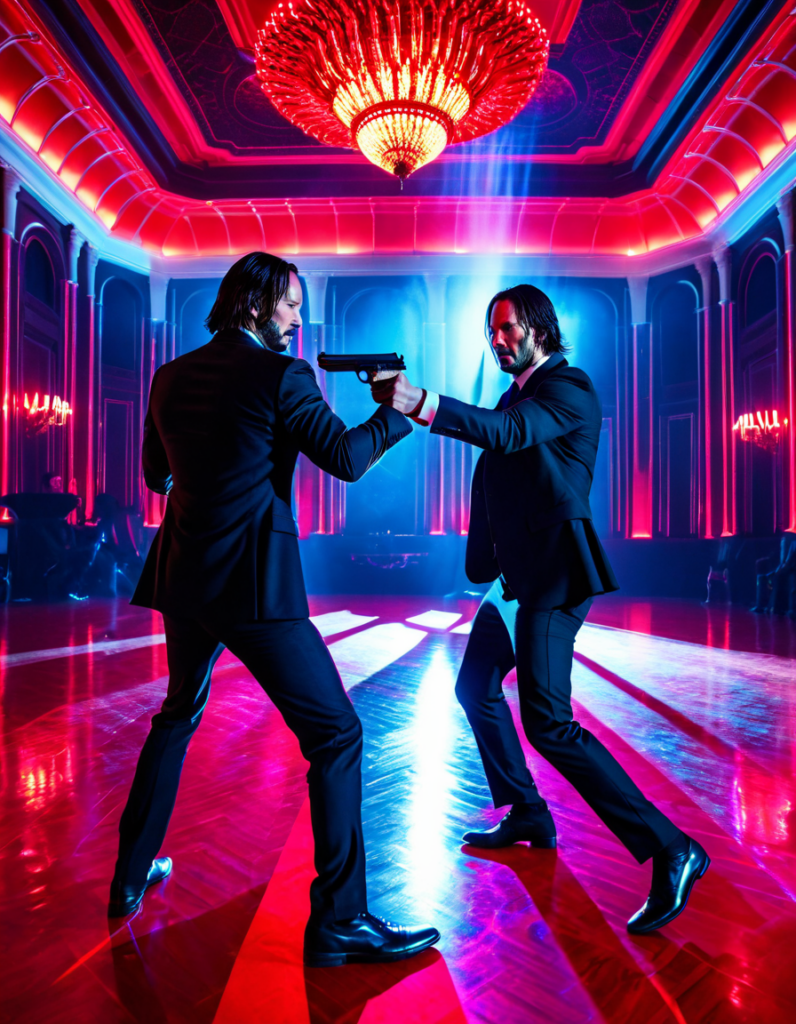
John Wick movies put you inside a world where discipline and choreography speak louder than exposition — and the stunt work is the reason we keep rewinding. Read on: these seven secrets lift the curtain on how the franchise became a global action language, who quietly elevates every scene, and what’s coming next.
1. John Wick movies: Keanu Reeves performs most of the fighting — how and why
87Eleven Action Design — Chad Stahelski & David Leitch’s training house
| Film | Year | Director | Runtime | Budget (approx.) | Worldwide gross (approx.) | Lead | Notes / Synopsis |
|---|---|---|---|---|---|---|---|
| John Wick | 2014 | Chad Stahelski | 101 min | ~$20M | ~$86M | Keanu Reeves | Retired hitman seeks vengeance after a home invasion; established franchise tone: stylized, practical-action choreography. |
| John Wick: Chapter 2 | 2017 | Chad Stahelski | 122 min | ~$40M | ~$171M | Keanu Reeves | Blood oath forces Wick back into the assassin underworld; expands the Continental/High Table mythology. |
| John Wick: Chapter 3 – Parabellum | 2019 | Chad Stahelski | 131 min | ~$75M | ~$326M | Keanu Reeves | On the run with a global bounty; noted for large-scale, inventive fight sequences and world-building. |
| John Wick: Chapter 4 | 2023 | Chad Stahelski | 169 min | ~$100M | ~$430M | Keanu Reeves | Escalates the conflict with the High Table across international locations; highest production scale and runtime. |
| Franchise summary (to mid‑2024) | 2014–2023 | — | — | Total budget ≈ $235M | Cumulative gross ≈ $1.0B | Keanu Reeves | Modern action franchise notable for choreography, stunt work, strong franchise branding and revitalizing Reeves’s action-star status. |
87Eleven is more than a stunt shop; it’s a culture factory that Chad Stahelski and David Leitch built after cutting their teeth in Hollywood. They turned a group of stunt performers into auteurs who think in camera beats and human rhythm rather than quick cuts. The studio’s ethos—long rehearsals, layered choreography, and an insistence on physical truth—made Keanu Reeves’ commitment possible and believable.
The 87Eleven approach trains actors to move like fighters, not just to punch on cue; that means partners learn to breathe together and hit marks while selling pain. Stahelski’s background as a stunt double on The Matrix informs that tactile, kinetic grammar—every step, every chambered round, and every fall is rehearsed until it looks effortless. The result is a visual grammar where camera placement and performer intent are indistinguishable, which keeps audiences hooked.
This house style also created a network effect: stunt leads, armourers, fight coordinators and actors who cut their teeth at 87Eleven now populate franchises and TV shows, spreading the “John Wick” DNA across the industry. That influence shows up in music videos, commercials and even unexpected internet pieces like Assenine, where timing and physical comedy echo action choreography principles.
Disciplines Keanu studied: judo, Brazilian jiu-jitsu, tactical pistol work and driving
Keanu Reeves didn’t just learn choreography—he studied disciplines. His training regimen across the series included Brazilian jiu-jitsu and judo for grappling and throws, dedicated pistol training for rapid reloading and transitions, and precision driving for multi-vehicle set pieces. This cross-training allows scenes to blend martial arts clinches with close-quarters shooting in a single continuous beat.
That breadth of study matters because each discipline informs the others. Judo teaches off-balancing an opponent and creating momentum; jiu-jitsu teaches control on the ground; tactical pistol training enforces stance and sighting under stress. Reeves’ willingness to bind these together makes the fights read as real exchanges rather than stunt beats, and it’s a major reason audiences buy into the character’s relentless efficiency.
Actors across genres now adopt similar hybrid training—some celebrities publicize their workouts (see how pop stars and athletes discuss their routines in lifestyle pieces about Normani), and the John Wick regimen sits on that continuum between celebrity fitness and professional combat training.
Preparation timelines: months of rehearsal, real-weapons simulations with armourers
Preparation for major John Wick sequences doesn’t happen overnight: productions typically schedule several months of rehearsal before cameras roll. Those months are not just blocking sessions; they include live-fire simulator drills with dedicated armourers, weapon transitions, and full-contact runs in costume. That’s why the film’s fights look simultaneously spontaneous and surgically precise.
Armourers on set control anything that can be dangerous, and they train actors on how to clear malfunctions and handle blanks safely. Practical effects teams coordinate with riggers, drivers and stunt coordinators so that every element—glass break, car impact, or pyrotechnic blast—functions on cue. The end product is cinematic confidence: long takes that let you appreciate choreography without fearing for the actor’s safety.
Producers also build rehearsal time into actor contracts because the franchise’s return on investment depends on that realism; audiences notice when a punch is “movie fake,” and they also share what feels authentic, which fuels word-of-mouth.
On-set reality vs. Movie magic — practical stunts, rehearsals and safety protocols
What you see in the final film is a blend: mostly practical, occasionally enhanced by subtle VFX. The franchise’s signature is its reliance on real contact—pulled punches that still create believable reactions—over quick cuts and invisible stunt doubles. That commitment involves repetitive rehearsal to lower unpredictability and rigorous safety protocols to protect performers.
Every stunt gets a risk assessment and a plan B; harnesses and airbags are hidden in the frame to preserve immersion, and long takes are prepped to the millimeter to keep both camera and performers safe. Cameras often move to undersell a safety rig rather than to cover sloppy choreography. This careful marriage of ingenuity and precaution is what allows an actor like Keanu Reeves to sell pain without paying for it on the hospital bill.
For viewers who enjoy deep dives into the culture around extreme experiences, the contrast between carefully staged action and reality echoes the fascination people have with dark endurance attractions such as Mckamey manor, though on set everything is about consent, professional control and safety.
Inside 87Eleven’s choreography: where “gun‑fu” and Hong Kong influence meet modern action
Matrix lineage — Stahelski’s stunt background and its imprint on John Wick aesthetics
Chad Stahelski’s history as a stunt double on The Matrix gave him a fluency in blending martial arts with camera trickery, and he carried that into the John Wick universe. Where The Matrix used wirework and philosophy, John Wick applies similar kinetic thinking to grounded, realistic violence. The result feels like a cousin to Hong Kong cinema but with Western culinary restraint: sparer, sharper, and fully committed to practical action.
That lineage explains recurring motifs—slow-burn build-ups, domino-effect fights and choreographic punctuation that reward audience attention. The aesthetic is less about flashy gravity-defying feats and more about believable escalation: a bar fight becomes a footnote in a hallway brawl that grows tighter and meaner. Audiences respond to this continuity of craft because it treats violence as technical language rather than spectacle alone.
Stahelski’s approach also influenced other directors who want that blend of clarity and style, pushing the industry toward longer takes with exacting choreography rather than an avalanche of edits.
Practical choreography principles: long takes, angles that sell contact, and rhythm
At the heart of 87Eleven choreography are three practical principles: long takes, camera angles that sell contact, and a clear rhythmic structure. Long takes let the camera appreciate sequence complexity; smart angles sell the illusion of impact without risky contact; and rhythm—repeated beats and tempo changes—creates emotional and visual punctuation.
These rules make the audience feel like an insider. When a slow precision moment explodes into a flurry, it lands because the film has been smart enough to train your eye.
Key collaborators and stunt leads (how crews like 87Eleven build reusable sequences)
A key advantage of 87Eleven is institutional memory: coordinators and stunt leads reuse and reinvent sequence templates across films. That means a hallway takedown pattern or a tactical reload choreography learned on one picture can be adapted and upgraded for another. Reusability speeds rehearsals and enables creative teams to iterate quickly.
Key collaborators—stunt coordinators, fight choreographers, armourers, and precision drivers—form tight units who speak the same physical language. This continuity produces the franchise’s trademark efficiency, and it helps directors forecast what can be achieved in a sequence. The team-based model also creates small Easter eggs for long-time viewers: a favor technique used in Chapter 2 might resurface more polished in Chapter 4.
This collaborative pipeline is partly why franchises with complex physical language scale better than those that rely on individual star power alone, and why the Wick model has influenced other action directors and productions.
Who are the surprising cameos? Notable faces that reward re-watches
Ian McShane (Winston) and Lance Reddick (Charon) — character work that anchors the world
Ian McShane and the late Lance Reddick provide emotional ballast to the kinetic chaos, and their work repays re-watches because they act inside the rules of an actual society. McShane’s Winston is a chessmaster who negotiates power through restraint; Reddick’s Charon used his quiet dignity to humanize the Continental’s staff and elevate every corridor scene he entered.
Their performances offer a master class in small-moment acting: a tilt of the head, a measured sentence, a look that flips the audience’s moral compass. These subtle, controlled choices give Keanu’s physicality a narrative home and make the world feel inhabited rather than just stylish.
Those background performances are also fertile ground for fans hunting Easter eggs—returning bit players and background stunt performers often carry forward tiny visual motifs that reward careful viewing.
Action standouts: Common (Cassian), Ruby Rose (Ares), John Leguizamo (Aurelio)
The franchise pulls in actors who can match the physical and tonal demands of the universe. Common’s Cassian sells the tragic weight of a professional killer, Ruby Rose’s Ares showed how a mute enforcer can be scarier than dialogue, and John Leguizamo’s Aurelio humanized the mechanic’s corner of the underworld with personality and heat. Each cameo or supporting turn gives a scene a distinct flavor and sometimes rewrites what we think the world values.
Those casting choices helped broaden the films’ appeal by blending dramatic actors with genre specialists, and the result is layered storytelling with a high-octane surface.
Global casting pulls: Donnie Yen and Bill Skarsgård in John Wick: Chapter 4 — how their roles shifted tone
John Wick: Chapter 4’s additions—Donnie Yen and Bill Skarsgård—highlight how casting can shift a franchise’s tonal palette. Donnie Yen brings a refined martial arts gravitas that increased the global action sensibility, while Bill Skarsgård’s presence added a menacing unpredictability that emphasized psychological threat over brute force. These casting moves signaled that the franchise could expand culturally and tonally without losing its core.
Their scenes changed how stakes are scored: an international star like Yen introduces choreography expectations from Eastern cinema, while Skarsgård rebalances the film’s villainous architecture toward menace and eccentricity. That tonal elasticity is part of why fans kept showing up.
For viewers who love spotting familiar faces in unexpected places, re-watching is rewarded, much like the joy of finding recurring background actors across properties similar to obscure entries discussed in pieces about Riley lewis.
Easter eggs — returning bit players, stunt performers doubled as background characters
The franchise hides affectionate nods in plain sight: stunt performers often appear as background characters, and bit players from early films can reappear in larger roles. These touches create a sense of continuity and a scavenger-hunt pleasure for dedicated fans. They also celebrate the unsung contributors—stunt drivers, fight partners and armourers—who keep the franchise alive.
Look for repeating tattoos, the same bartender in a reopened locale, or a tossed prop that echoes an earlier film; these details prove the production cares about internal logic. Re-watching with an eye for these easter eggs deepens appreciation for the sheer craft on display.
Why the Continental’s rules matter — small details with big consequences

The code explained: markers, rules of sanctuary and the currency of the underworld
The Continental’s rules—markers, sanctuary, and the currency system—aren’t just worldbuilding window-dressing; they create narrative consequences that drive character choices. Markers operate like iron-clad contracts that can force characters into impossible decisions, sanctuary gives the world a believability of neutral ground, and the underworld’s coinage and status create a functioning economy for storytelling.
These formal rules let writers stage moral dilemmas that feel logical. When a character breaks a marker or abuses the Continental’s protections, the penalty feels earned because it violates an established social contract. That’s smart writing: rules make rebellion meaningful.
Because the rules are specific, they allow writers and directors to craft surprises without resorting to deus ex machina. The audience learns to track the code and gains pleasure from seeing it manipulated or upheld.
The Continental on screen and off: how the Peacock series The Continental (2023) expanded lore
The Peacock prequel series The Continental—which explored young Winston’s rise and the hotel’s origins—expanded the franchise’s legal and cultural architecture. By drilling down into institutions that previously served as backdrop, the series made the Continental feel like a living city-state with investment, intrigue and rival factions.
Television allowed time to unpack how the rules emerged and who enforces them, lending historical texture to decisions characters later make in the films. The series also explored power dynamics from different angles, introducing new players whose choices ripple into the mainline films. This cross-pollination deepens the universe and creates story hooks that studios can cash in on across formats.
(If you want a contrast about how prestige TV and franchise expansions intersect with mainstream period pieces, see the Motion Picture Magazine coverage for Bridgerton season 4.)
Character implications — Winston’s choices (Ian McShane) and Charon’s legacy after Lance Reddick
Winston’s decisions often hinge on his interpretation of the Continental’s code, and those choices carry moral ambiguity. Ian McShane’s performance frames Winston as both guardian and geopolitical actor—someone who uses the rules to exercise power rather than simply follow them. The stakes of his choices ripple across the underworld and change who survives.
After Lance Reddick’s passing, Charon’s legacy endures in the way the films memorialize loyalty, procedural dignity and quiet authority. Writers and actors have used that absence to underscore the idea that rules evolve with personalities and losses, and that institutional memory matters.
These character dynamics make meaty narrative soil for spinoffs and allow subtle human drama to grow inside a world built on assassins and ledgers.
Behind the camera: Chad Stahelski’s stuntman‑to‑director blueprint
Career arc: from stunt double on The Matrix to directing all John Wick films so far
Chad Stahelski’s trajectory—from stunt double to auteur—illustrates how practical experience can reshape genre filmmaking. His work on The Matrix taught him how choreography and camera can co-author a film, and as a director he applied that lesson to create films that are both kinetic and narratively precise. Stahelski’s insistence on in-camera problem solving and practical stunt bases the franchise’s signature.
That background also built trust among actors and crew: performers know he understands the mechanics of danger, so they accept longer rehearsals and more exacting physical demands. The result is a unified production culture that prioritizes craft over shortcuts.
Stahelski’s path has inspired other stunt professionals to pursue directorial roles, shifting industry perceptions about who gets to helm action stories and how that experience benefits safety and storytelling.
Visual and practical priorities — why Stahelski favors real locations, stunt choreography and minimal CGI
Stahelski’s visual priorities are pragmatic: real locations, real cars, and bodies moving in real space. Minimal CGI preserves texture—sweat, bruises, and scuffed floors—so the viewer feels present rather than watching a simulation. That practical aesthetic also constrains creativity in helpful ways, forcing choreographers to find solutions that read better on camera rather than in post-production.
Shooting on location provides unpredictable variables that enrich staging—different floor surfaces, corners and weather create unique challenges that make choreography inventive. Those constraints become assets: they push teams to rehearse more and to tune performances to the environment rather than to a green screen.
This philosophy echoes a larger industry conversation about the value of practical effects and how they coexist with digital tools, a debate visible across contemporary productions and revivals, from rebooted TV properties to revitalized sci-fi projects like the rumored demascus tubi sci fi series revival.
Writer-director interplay: Derek Kolstad’s creation and later writers who broadened the world
Derek Kolstad created the John Wick template—its economy, code, and stripped-down mythos—but the franchise’s expansion owes as much to collaborative writers and directors who layered new politics, locales and tonal shifts. Later writers broadened the world’s institutions and international scope, giving directors new playgrounds to test choreography and narrative stakes.
This interplay is crucial: a director like Stahelski needs a codified world that allows for escalation without collapsing into incoherence. The writers supply rules and consequences; the director supplies the visual language to make those rules visceral. Together they built a franchise that can pivot between intimate fights and globe-trotting set pieces while keeping thematic coherence.
The franchise’s model shows how strong IP grows when creative roles respect the underlying rules while daring to expand them.
Box-office & spin-offs: how the franchise became a multimedia universe
From sleeper hit to franchise engine — how audiences turned John Wick into a tentpole
John Wick started as a lean, obsessive thriller that surprised studios and audiences by delivering style with substance. Positive word-of-mouth and a devoted action community turned that initial curiosity into a sustainable franchise. Each successive film grew in scope, bringing higher grosses, bigger set pieces and a hunger for more worldbuilding.
The transition from sleeper to tentpole was organic: fans rewarded continuity and craft, streaming platforms amplified reach, and international box office buoyed ambitious production budgets. The films’ focus on economy-of-story and spectacle-of-skill produced a blueprint other action filmmakers have followed.
That growth also attracted actors who typically move between genres—think of performers who balance arthouse and blockbuster work like those you’d find in lists of Christian bale Movies Or Dwayne johnson Movies—and it made the Wick world a place actors wanted to join.
Official expansions: Ballerina (starring Ana de Armas) and the Peacock series The Continental (Mel Gibson, Colin Woodell)
The universe officially expanded with theatrical and streaming projects. The spin-off film Ballerina (starring Ana de Armas) explored a new corner of the assassin ecosystem with a female-led revenge narrative that preserved the action DNA while exploring a different tone. The Peacock prequel series The Continental Dug into origin stories and institutional politics, bringing new actors like Mel Gibson and Colin Woodell into the fold and deepening canon.
These expansions kept the franchise’s stylistic DNA—practical fights, rule-based conflict and moral ambiguity—while letting creators experiment with form. Spin-offs work because they respect the mechanics of the original world while offering fresh perspectives and different emotional textures.
For example, Ballerina leaned into balletic violence and close-up intimacy, demonstrating how the franchise DNA can support many tonal directions.
How spin-offs preserve the action DNA while exploring new tones and corners of the assassin world
Spin-offs preserve DNA by keeping core rules—markers, Continental sanctity, and a professional code—while shifting vantage points. That lets writers and directors explore revenge, politics, or institutional drama without betraying the series’ logic. Spin-offs also let supporting characters get center stage, which fans reward because they already understand the stakes.
This model has inspired studios to greenlight different forms of expansions—films, streaming series and even comics—knowing that a shared logic can carry audience investment across formats. The franchise’s success in this regard invites comparisons to how other modern filmmakers expand genre worlds, a strategy visible in creators behind Jordan Peele Movies.
What 2026 means for Wick: announced projects, casting hints and where to watch
Where things stand: officially released spinoffs vs. Projects reported in development (status updates)
By 2026, the core film series rests on four main entries and an expanding slate of official spinoffs. Ballerina hit theaters and Peacock’s The Continental completed its initial arc, while studio statements referenced additional projects in development, including potential sequels and new character-centric films. John Wick: Chapter 5 has been discussed publicly as conditional on creative alignment and financing, rather than locked-in production.
Studios now balance theatrical windows with streaming release plans: big action tentpoles will often get a theatrical first window and then a timed streaming debut, giving fans multiple ways to catch up. This staggered model matters for collectors and superfans who want to own high-frame-rate or extended-cut editions.
As always with franchise TV and film pipelines, projects in early development are fluid—ideas that look certain one quarter can change the next—so fans should temper expectations while enjoying confirmed releases.
Casting & creative rumors to watch — what would change the franchise’s direction
Casting rumors tend to swirl, and the franchise’s appetite for eclectic actors means almost anything gets floated—from indie darlings to mainstream action stars. The franchise’s next direction could shift if it brings in a stylistic auteur or a marquee action name. Imagine a tone-shift if a performer associated with heavy character work—think of actors who pick strong dramatic roles across lists of Will Poulter Movies Or even a muscle-bound star familiar from Dwayne johnson Movies—joined the roster.
Other rumors mention younger leads and international stars—those choices would expand the franchise’s global reach and could pivot the series toward different subgenres, such as the more operatic or the more intimate. Keep an eye on casting announcements: a single high-profile addition can recenter the franchise’s narrative axis.
The franchise also pulls from diverse talent pools; expect surprises and crossovers from other media, whether a pop artist cameo in a nightclub sequence or a TV actor transitioning to the big screen.
How to stream, buy or binge the world right now (theatrical window notes, Peacock and digital options)
As of early 2026, the best ways to watch the franchise are a mix of physical ownership, digital storefronts, theatrical re-releases and streaming windows. Films typically enjoy a theatrical release followed by a premium digital window, then move to licensed streaming platforms and, occasionally, to the studio’s preferred streaming partner for timed exclusivity. For example, the Peacock series remains a go-to place for prequel content and exclusive spin-off material.
If you prefer curated binging, check the major digital retailers for high-quality downloads and Blu-ray collector editions that include behind-the-scenes features and extended fight breakdowns. For casual re-watching, streaming windows make the films accessible without ownership, but collectors should keep an eye on limited edition physical releases for extras and archival value.
For readers who enjoy comparing how franchises expand across platforms, there are thoughtful retrospectives on how other series live across media, from TV remakes to pop culture revival pieces like Gilligans island, and coverage of adjacent industry moves that reflect changing distribution models.
John Wick movies built a language of violence, a code of honor, and a machinery of production that respects craft above noise. Whether you re-watch for choreography, dig for cameos, or follow the spin-offs, the franchise rewards attention—and it keeps evolving. If you loved the world’s rules and want more behind-the-scenes lore, share this with a friend and argue about your favorite fight sequence (be nice — violence is cinematic, not conversational).
John Wick movies: Fun Trivia You’ll Actually Want to Know
Fast, Furious, and Filthy-Cool Facts
Believe it or not, John Wick movies pushed Keanu Reeves to learn real firearms handling and driving, so many sequences feel raw because he did many of his own stunts — and you can tell; the gun-fu scenes were choreographed by ex-stunt pros who treated each move like a dance. The films use practical effects and real cars for chase beats, which explains why the commotion on-screen hits so hard, and by the way, the gold coins used as Continental currency were crafted as tangible props that actors could actually trade. Speaking of surprising locations, some set choices nod to offbeat Americana, a vibe you’d spot if you ever wandered into a place like Kroc Rows , odd but kind Of fitting For Those shadowy hotel Corridors .
Behind-the-Scenes Nuggets
Chad Stahelski’s background as a stuntman shaped the John Wick movies’ rhythm: fights are short, brutal, character-driven, and shot to preserve spatial clarity so viewers always know who’s left standing. Casting sometimes pulled in actors fresh from prestige TV, which added texture to bit parts and gave fight scenes unexpected soul — think performers with stage or anthology show chops, the same way folks crossover from projects like Albie white lotus . Oh , And Dogs ? They ’ re more Than props ; The canine Moments reset The stakes emotionally , Which , frankly , Is why The Films hit You in The gut .

This article was produced with AI assistance. How Motion Picture Magazine uses AI.
Motion Picture Magazine writes for Motion Picture Magazine — movies, celebrity gossip, entertainment news, style and best shows.